AIRDOS05 - Airborne radiation sensor with external display
AIRDOS is an automation-ready cosmic radiation dosimeter and spectrometer unit. It is intended for long-term high-altitude (above FL490 or 15000 a.m.s.l.) airborne measurement of cosmic radiation and dosimetry in mixed ionising radiation fields on board aircraft.
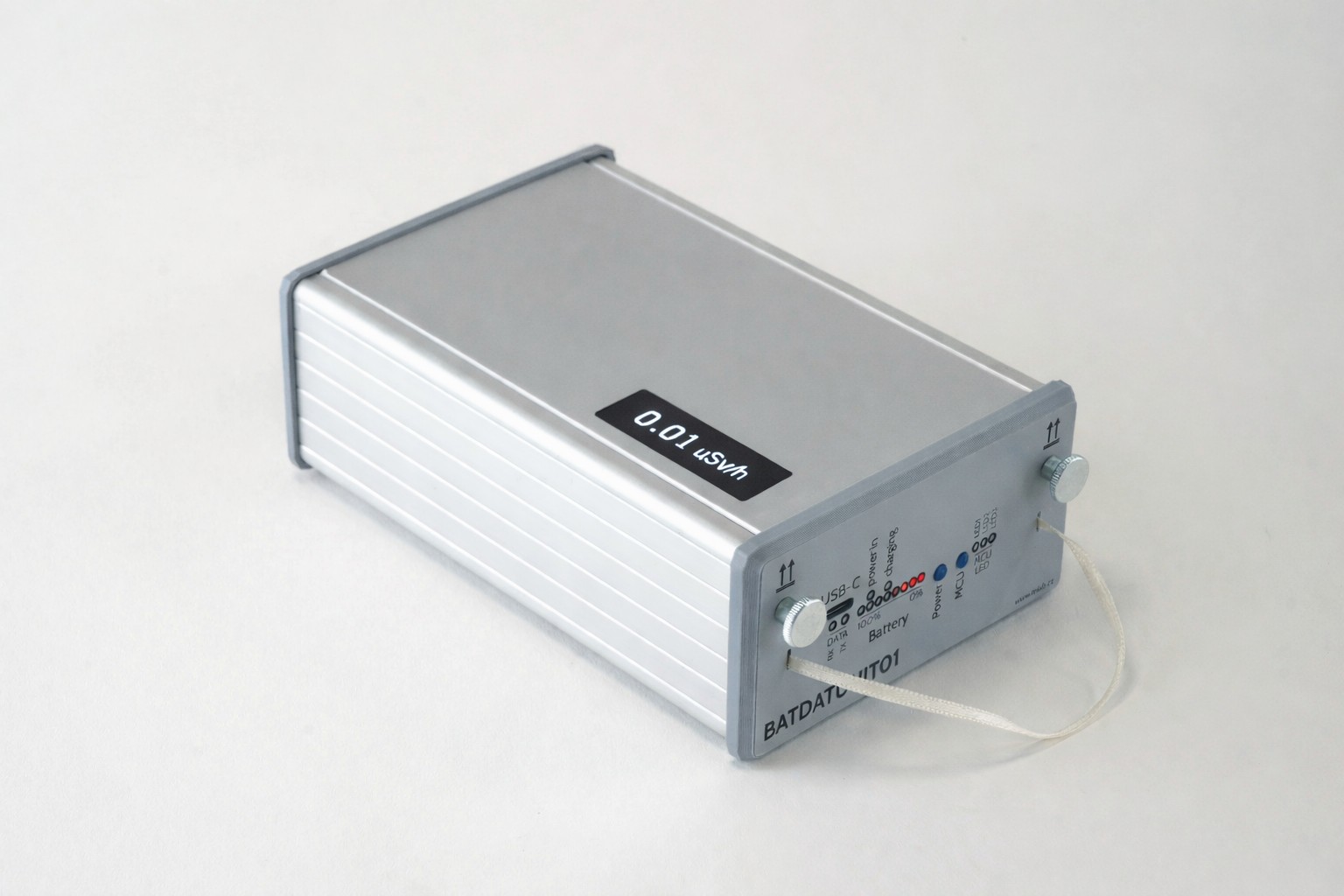
The instrument is designed primarily for the dosimetry of cabin crew and commercial flight attendants. Thanks to its design of detachable data storage and power source from accumulators, the required maintenance time is minimal. The calibrated AIRDOS05 detector can be placed on board continuously, and it is only necessary to replace the accumulator/storage module according to the set maintenance interval.
Applications
- Cosmic radiation field research at flight altitudes
- Benchmarking and validation of radiation models
- High-altitude airborne dosimetry indicator
- Space-weather related radiation studies
- Reference dosimeter for comparative measurements
External Dosimeter Display Unit
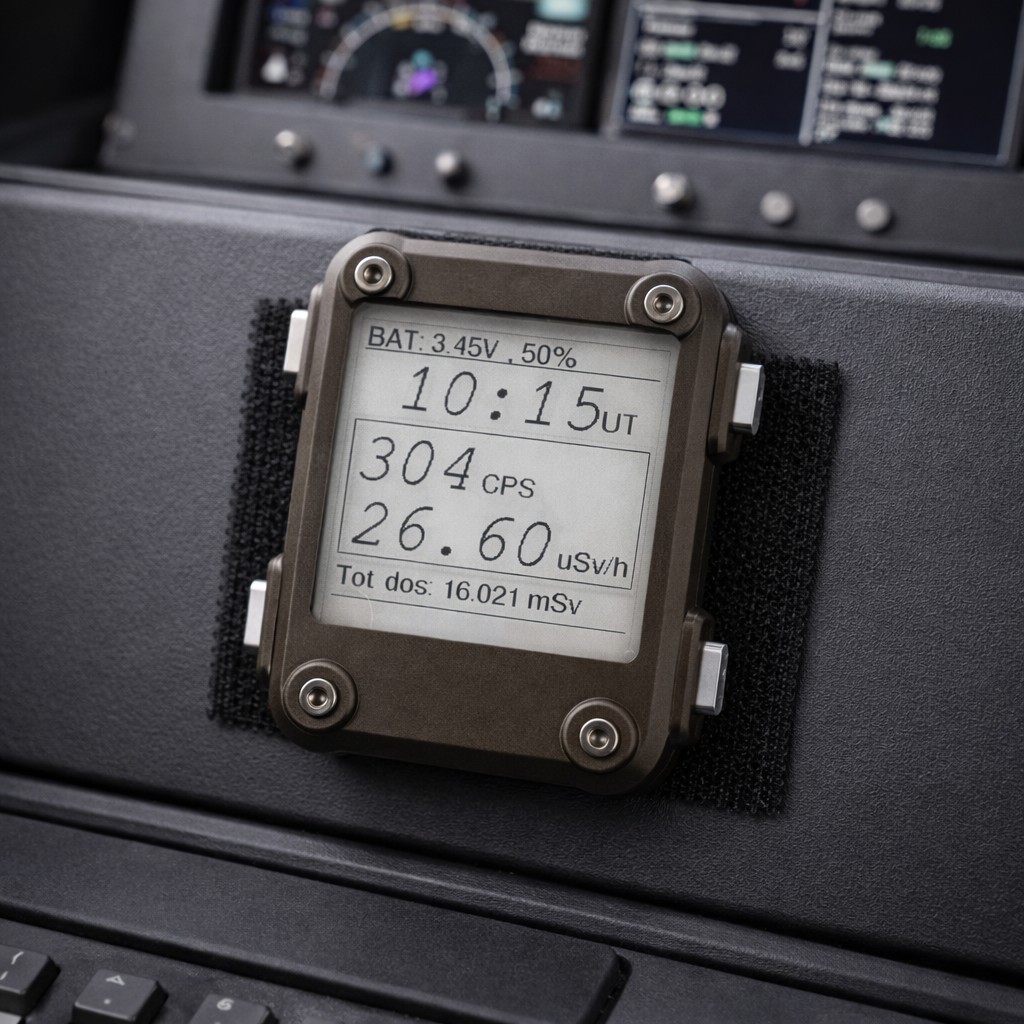
ICAO Annex 6 (Part I) requires that aeroplanes intended to be operated above 15,000 m (49,000 ft) carry equipment that continuously indicates the total cosmic-radiation dose rate being received and the cumulative dose on each flight, with a display readily visible to a flight crew member. For this purpose, AIRDOS05 can be complemented by an external Dosimeter Display Unit (DDU) that presents the current dose-rate and accumulated dose directly to the crew. The DDU can be placed in the cockpit at a suitable location, for example, using a hook-and-loop fastener, as shown in the photograph below.
Technical parameters
DDU Specification
- Dimensions: 46 x 35.5 x 9.5 mm
- Display:
- Resolution: 200(H) × 200(V)
- Active Area: 27 × 27 mm
- Power supply:
- Battery LiPo Battery 3.7V 200mAh
- USB charging
- 24-hour endurance after charging
- Data interface: Bluetooth LE 5.0
- Mass: 13g
AIRDOS05 Specification
- Detection element: Silicon PIN diode, volume 44 mm³
- Effective number of energy channels: ~65000
- Deposited energy range: 40 keV to 80 MeV
- Energy measurement resolution: 15 ±2 keV
- Service interface and charging source: USB-C connector
- DDU interface: Bluetooth LE 5.0
- Optional OLED display
- Energy source: Up to five 18650 Li-ion cells with 64 Wh in total. That conforms ≤ 100 Wh / 2g IATA restrictions
- Can also be operated without accumulators completely with the use of an aircraft’s on-board USB power source.
- Radiation spectra integration time: 10 s
- Environmental sensors
- Relative Humidity 0 to 100 %RH (accuracy 2 %RH)
- Temperature -40 to 125 °C (accuracy 0.5 °C)
- Barometric pressure 1 to 120 kPa (accuracy 150 Pa)
- Inertial Measurement Unit (Magnetometer, Gyroscope, Accelerometer) - Not yet implemented in firmware
- Mode-S ADS-B Receiver for flight trajectory tracking - Not yet implemented in firmware
- Maintenance interval: ~1 month (data download, accu pack change)
- Maintenance duration: under 5 minutes
- Size: 166 x 107 x 57 mm (two of these should fit into the Aircraft printed manual bay)
- Weight is 0.88 kg (With five Li-ion accumulator cells in BATDATUNIT01)
- 0.62 kg without Li-ion accumulators
- Environmental operational conditions
- Device protection: IP30 rating (fully assembled)
- Operational and storage temperature range: 0°C to 50°C (32°F to 122°F)
- Operational humidity conditions: non-condensing, 20% to 80% RH
Note: Technical specifications are subject to change without prior notice as we continuously improve our devices. Any changes are made to enhance performance, usability, or compliance.
Examples of data
AIRDOS05 detection technology is based on AIRDOS04, which has been verified in well‑characterized reference radiation fields, during operational airline flights, and on stratospheric balloon campaigns. The following sections demonstrate the instrument’s capabilities in mixed fields dominated by charged particles.
Verification on artificial radiation sources
AIRDOS04/05 has undergone beam/field exposures at the following facilities :
- HIMAC (Heavy‑Ion Medical Accelerator in Chiba, Japan) — a clinical/research synchrotron complex delivering high‑energy heavy‑ion beams with precise energy and intensity control. It is widely used to study fragmentation and dosimetry in well‑defined mono‑species beams.
- CERF at CERN (CERN‑EU High‑Energy Reference Field) — a mixed high‑energy hadron field created from secondary particles in a controlled geometry, routinely used to benchmark dosimeters and spectrometers in conditions representative of aviation altitudes.
These facilities let us test AIRDOS04/05 in both mono‑energetic/mono‑species and mixed‑field scenarios.
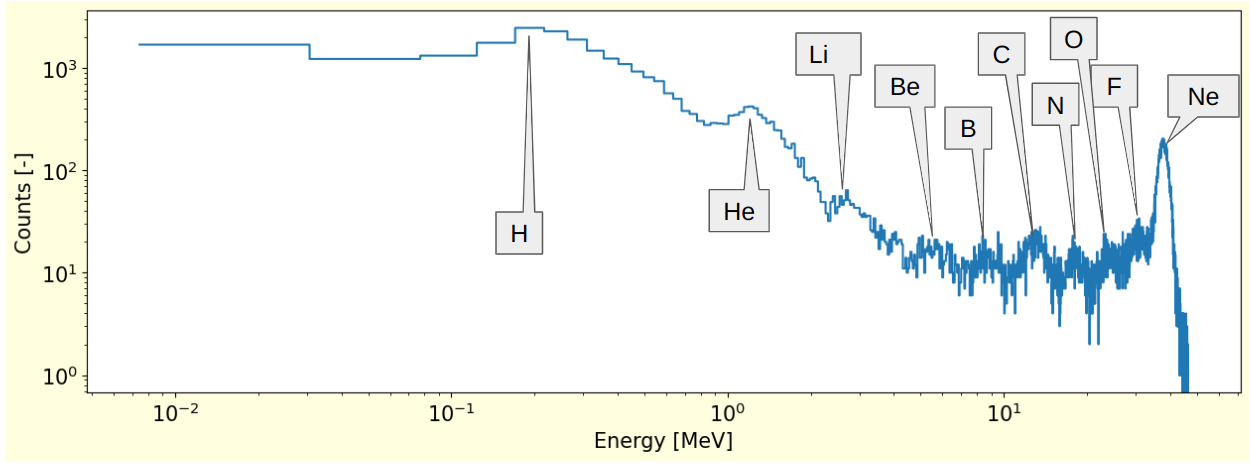 HIMAC exposure: heavy‑ion interactions and nuclear fragmentation features are visible at high deposited energies, confirming the spectrometric response and dynamic range.
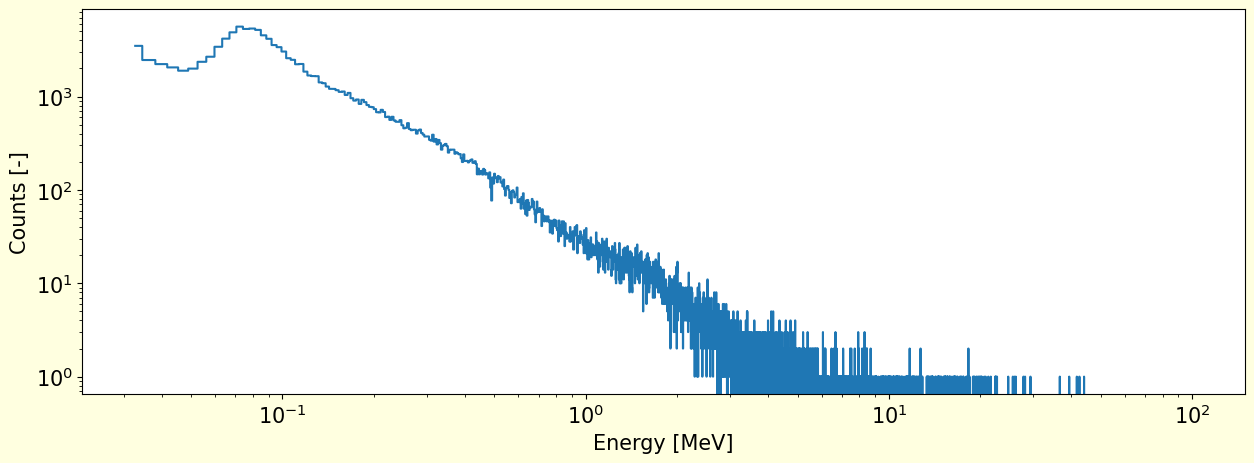 CERF exposure: spectrum measured in a standardized mixed high‑energy field; spectral shape and rates are consistent with the reference field characterization.
Energy calibration (Am‑241 & Pu‑239)
Each produced AIRDOS04/05 unit is individually energy‑calibrated using two reference sources, Am‑241 and Pu‑239. A calibration protocol is supplied with every delivered instrument.
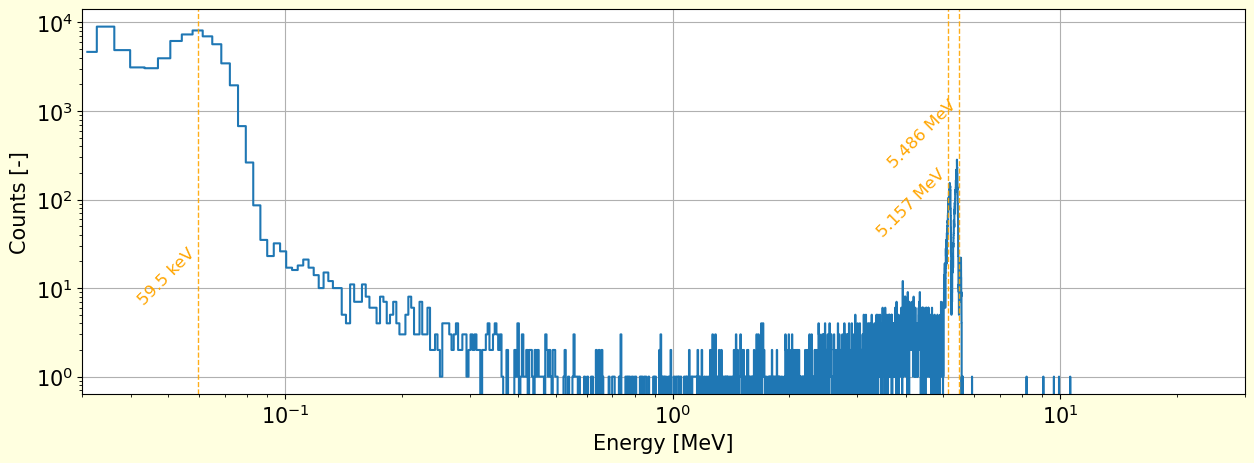 Energy‑calibration spectrum from a typical unit. Labelled lines correspond to distinct radiation types and serve as fixed points for the channel‑to‑energy conversion.
Identified energies and radiation types:
- 59.5 keV (γ from Am‑241): Low‑energy gamma line used as the lowest-energy calibration anchor; in silicon it produces a well‑defined full‑energy peak (dominated by photoelectric absorption), validating the low‑noise of the spectrometer.
- 5.486 MeV (α from Am‑241): High‑energy alpha‑particle line; alphas of this energy stop within tens of micrometres in Si and deposit essentially their full energy, providing a sharp peak for the MeV‑range anchor and resolution check.
- 5.15 MeV (α from Pu‑239): Second alpha line near the Am‑241 peak; the ≈0.336 MeV separation between the two alpha lines is a sensitive cross‑check of the energy scale and spectral resolution.
These three lines jointly establish the keV‑per‑channel calibration and verify the detector’s linearity from tens of keV up to several MeV.
Flight-data
During routine operations, AIRDOS04/05 records the evolution of the cabin radiation environment. The figures below show a representative flight where the dose rate rises with climb, levels at cruise, and decreases on descent; the spectral content and environmental variables (pressure, temperature) evolve accordingly.
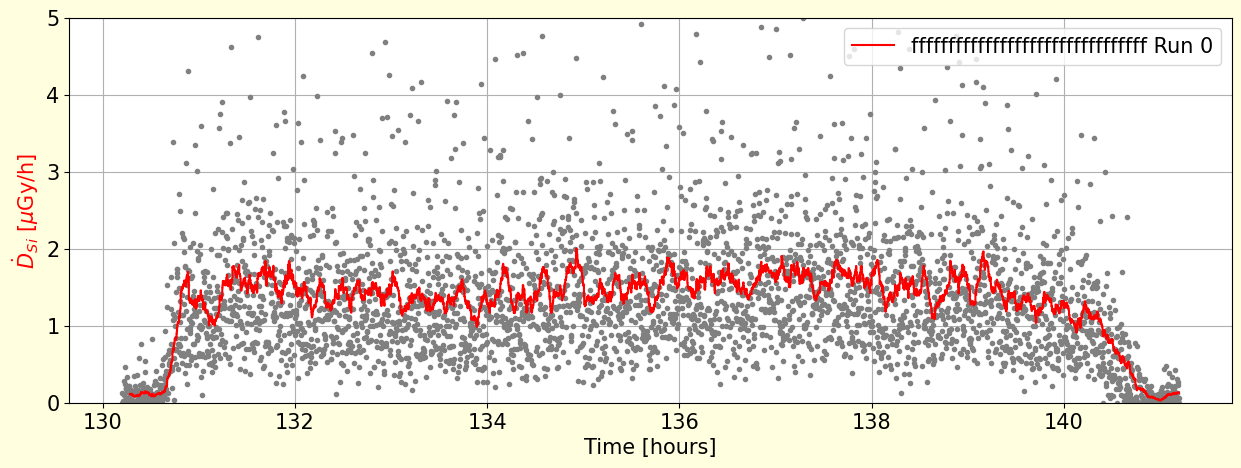
Dose‑rate vs. time along the flight profile.
- Flight duration: 11 h, number of spectral measurements: 3854.
- Dose in silicon over the flight: 14.444 μGy ± 1.132 μGy.
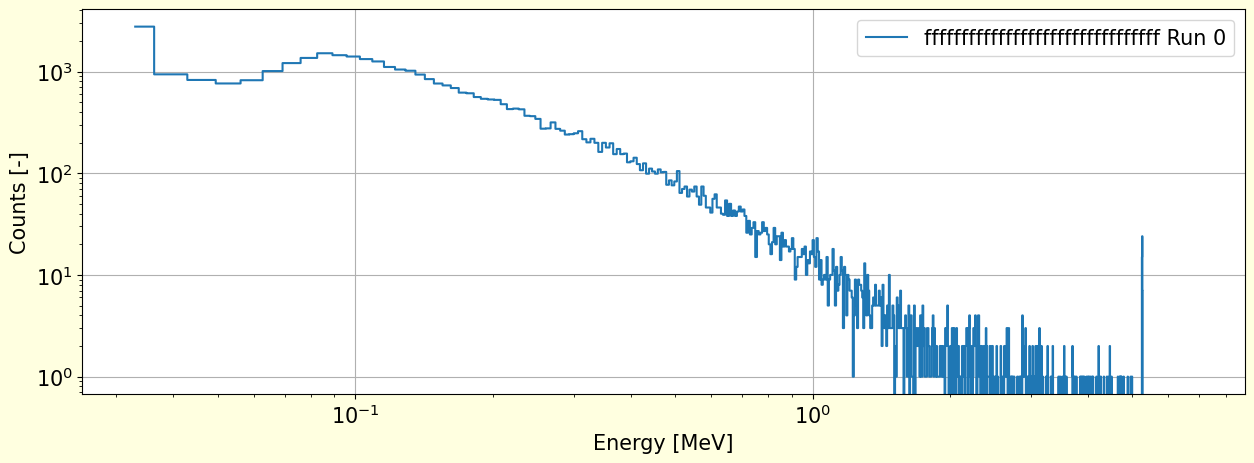 In‑flight deposited‑energy spectra.
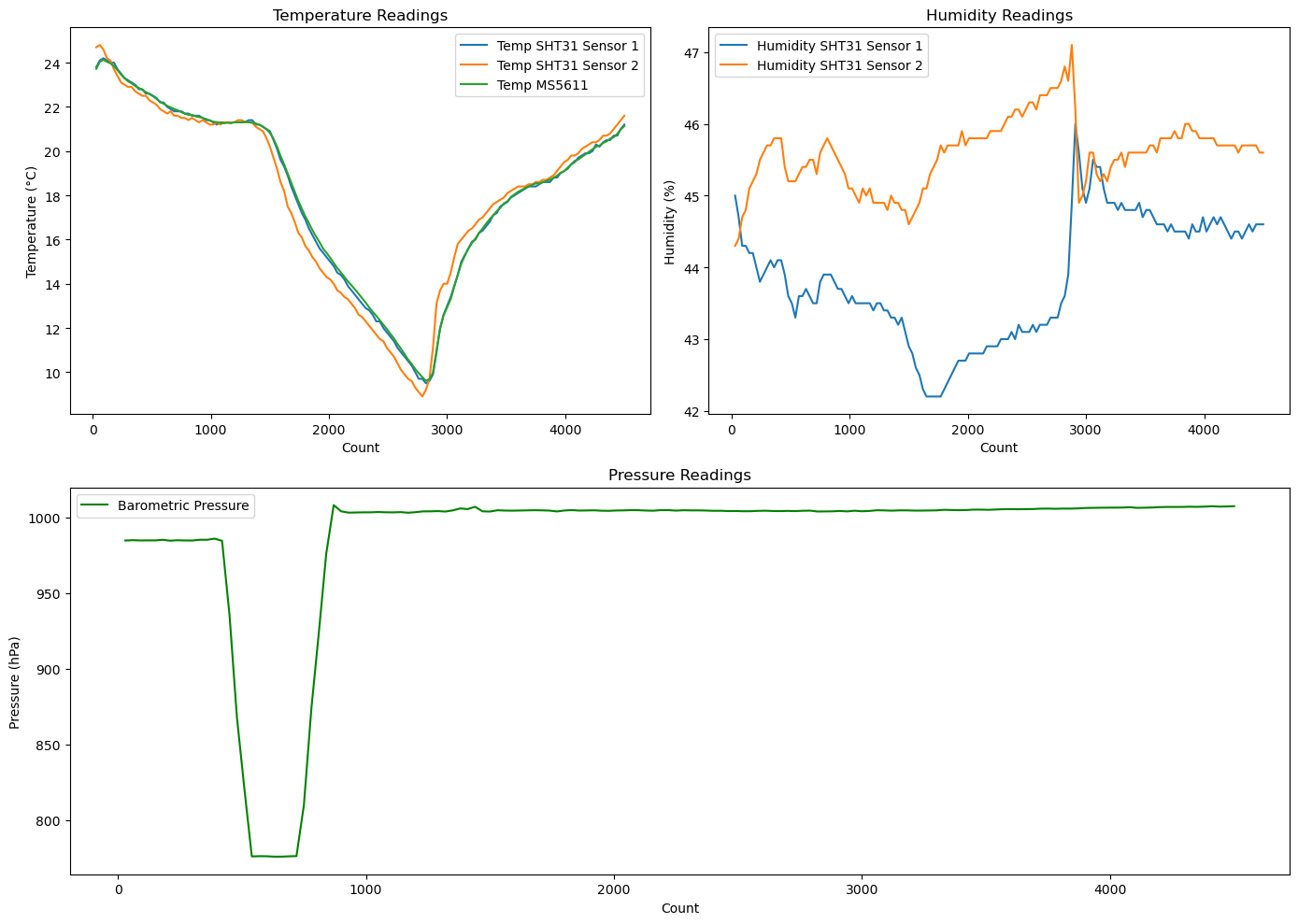 Concurrent pressure and temperature records provide context for ascent/cruise/descent phases and help correlate aircraft flight-phases with radiation trends.