GEODOS01 – Stand-alone Ionizing Radiation Monitor
GEODOS01 is a scintillation detector for ionizing radiation, designed for long-term unattended outdoor operation. Its construction makes it particularly suitable for deployment in mountain regions or remote areas where power and network access are limited.
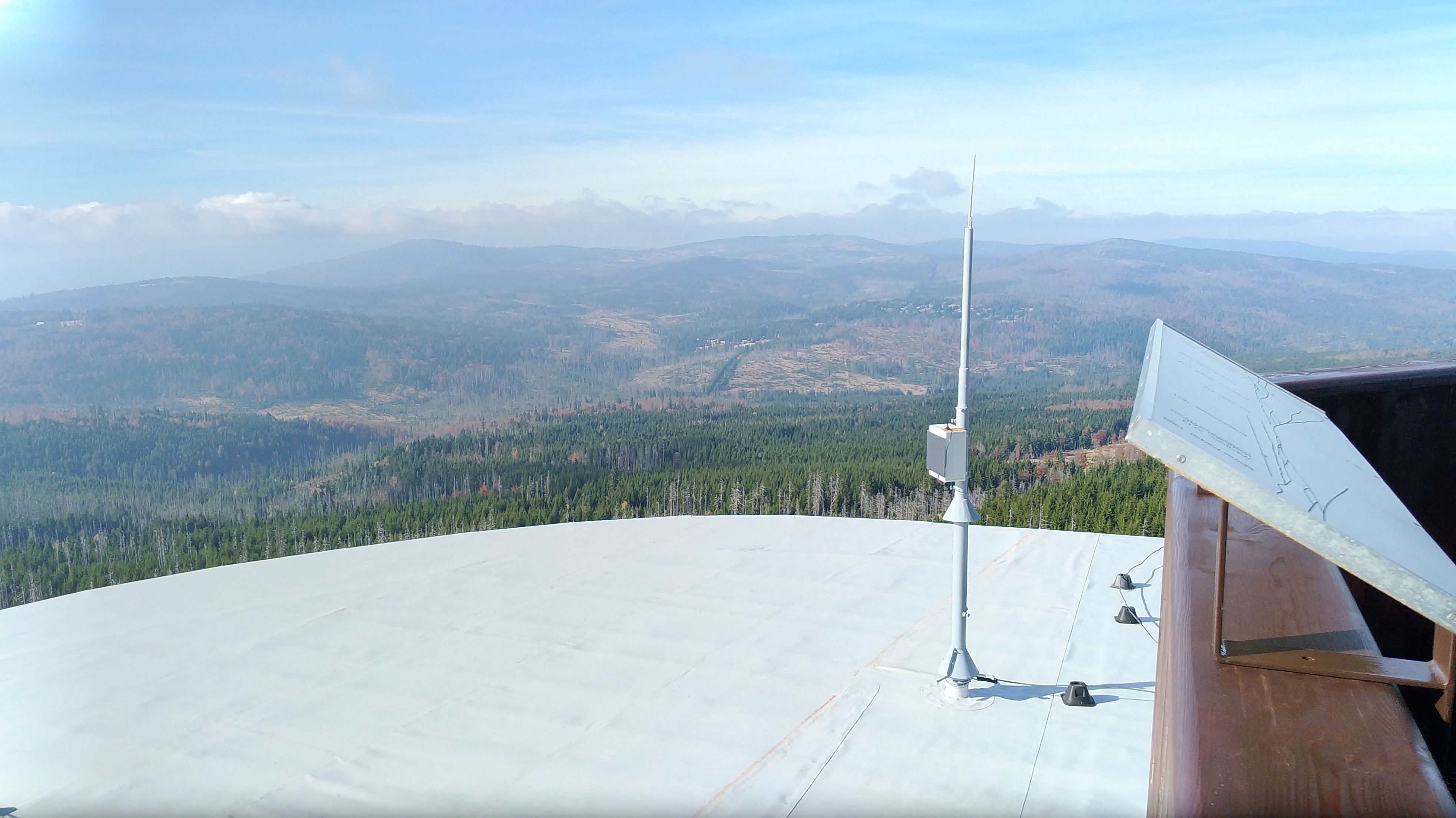
Overview
The device provides fully autonomous detection, logging, and telemetry of radiation events, including backup power and solar charging. It is a robust system proven in long-term environmental monitoring campaigns and scientific research projects, including installations in the Šumava Mountains, Chernobyl Red Forest, and Kosetice Atmospheric Tower.
GEODOS01 serves as a reference instrument in several CRREAT project installations for studying thunderstorm-related radiation phenomena.
Key Features
- Detection element: NaI(Tl) scintillation crystal (⌀14×20 mm) with integrated SiPM
- Power source: solar panel with LTO battery backup
- Data logging: SD card storage
- Communication: LoRa IoT telemetry
- Time accuracy: 500 ns
- Spectral resolution: 0.02 MeV
- Operational range: −30 °C to +50 °C
- Measurement autonomy: ~6 months per 2 GB SD card
- Open‑source hardware and firmware
Technical Specifications
| Parameter | Value |
|---|---|
| Detection crystal | NaI(Tl) ⌀14 mm × 20 mm with SiPM |
| Energy range | 0.3 – 18 MeV |
| Time resolution | 20 µs |
| ADC conversion time | 104 µs |
| Dead time | 2 µs |
| Power | Solar panel + LTO backup |
| Data storage | SD card |
| Communication | LoRa WAN |
| Operating temperature | −30 °C to +50 °C |
| Enclosure | Spelsberg TK PS 2518‑11‑o (IP33) |
Data and Communication
GEODOS01 transmits data using an NMEA‑0183‑like textual protocol with two primary message types:
Histogram message
$HIST,8,118.15,960.09,4.06,2.33,394,803,0,3,30656,2401,...
Represents accumulated energy histogram values.
Events message
$HITS,20,916,84,2984,37,16386,38,30666,26,...
Reports individual radiation events with timestamp and energy channel.
EMI immunity — lightning current generator test
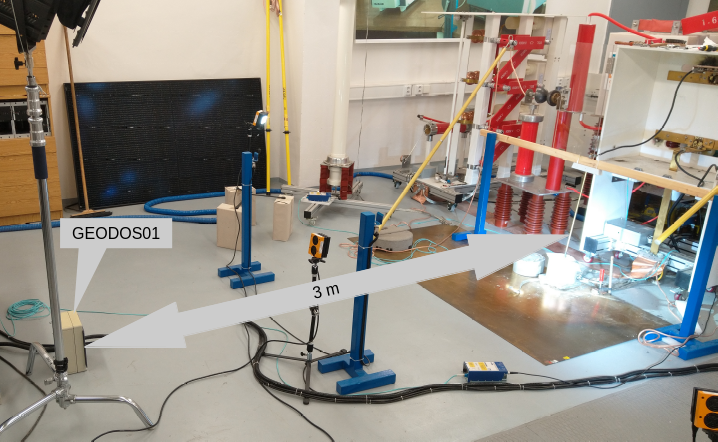
A GEODOS01 deployed near lightning will be exposed to extremely strong transient electromagnetic fields. To verify that the detector and its electronics are not susceptible to false counts under such conditions, the GEODOS01 was tested next to a high-current discharge generator delivering standardised 85 kA, 10/350 µs waveforms — the same waveform that IEC 62305 uses as a synthetic lightning-current proxy. The detector was placed at 3 m from the discharge setup:
The recorded total count rate during the test, integrated in 10 s windows, shows no deviation or transient increase coincident with the discharge events:
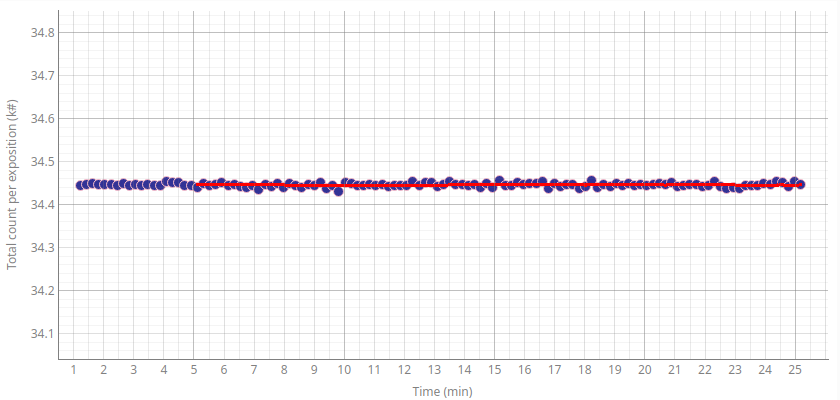
The test confirms that the detector signal chain and shielding are sufficiently resistant to the transient EM fields produced during a lightning discharge. The 85 kA, 10/350 µs waveform is a technical approximation that cannot reproduce the full variability of natural lightning (source geometry, spectral content, rise times, and the spatial distribution of radiated fields) — but it is the most rigorous and reproducible laboratory proxy currently available.
Radon-progeny washout — the standard ground-level signal
Before any radiation excursion measured by a GEODOS01 during a thunderstorm can be interpreted as a thunderstorm-related enhancement, one well-known confounding effect has to be excluded: radon-progeny washout.
Radon (²²²Rn) continuously emanates from soil and rock at the ground surface; once airborne it decays through a short chain of short-lived progeny (²¹⁸Po, ²¹⁴Pb, ²¹⁴Bi, ²¹⁴Po). Several of these progeny are γ-emitters and they normally remain at low concentration aloft. Rainfall — including the rain that precedes and accompanies a thunderstorm — scavenges these aerosol-bound progeny out of the lower atmosphere and deposits them on the ground in concentrated form. As a result, every ground-level scintillation detector sees a temporary rise in the gamma background by tens of percent, beginning shortly after the onset of rainfall and decaying over the next 30–60 minutes (the natural half-life of the dominant progeny).
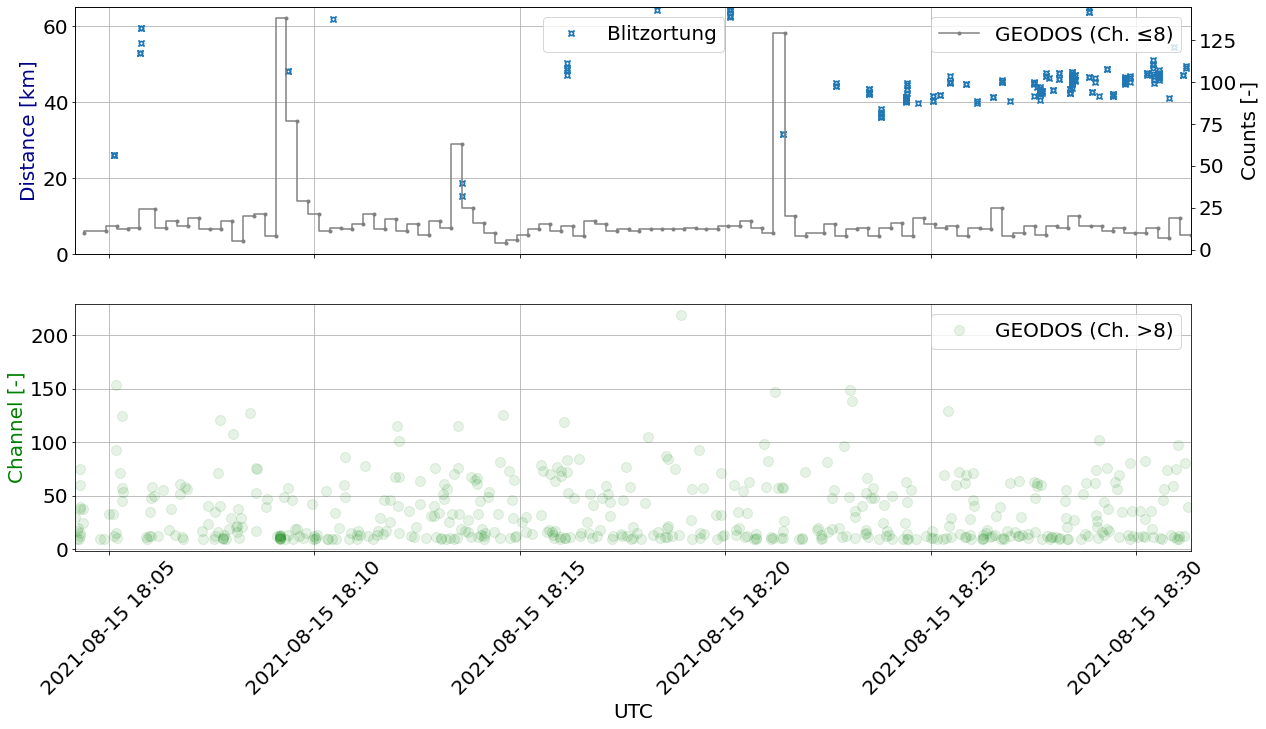
The example below illustrates the magnitude and timing of this signal. A gamma spectrometer (an AIRDOS-C unit; the phenomenon is identical for GEODOS01 — they are the same class of NaI(Tl) + SiPM scintillation detector) was deployed in a parked vehicle near a thunderstorm. The upper graph shows lightning activity from Blitzortung.org; the lower graph shows the detector count rate in 15 s bins. Lightning activity ceased just after 20:30, while the count rate rose by approximately 30 % after rainfall onset at 19:45:
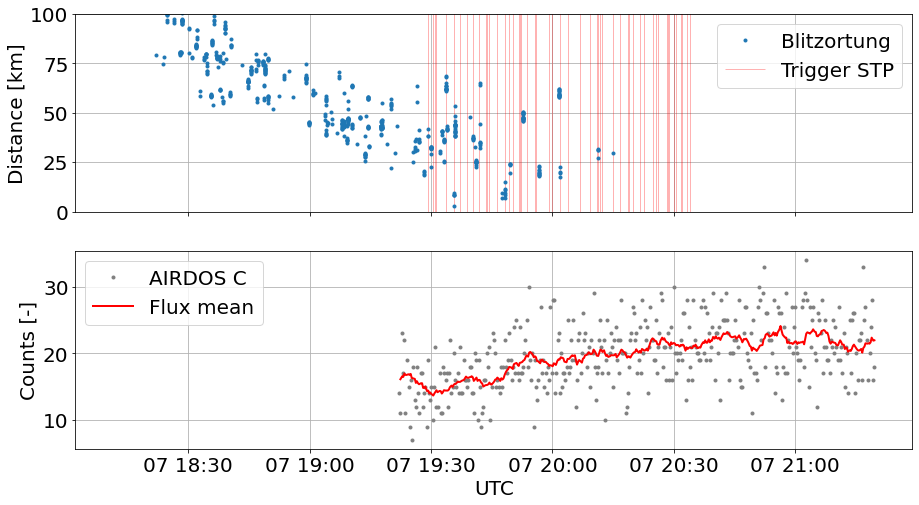
The detail figure below shows that the high-energy part of the spectrum (above ~2.4 MeV) is unaffected — the washout signal is dominated by the well-known ²¹⁴Bi and ²¹⁴Pb gamma lines well below that threshold. So a true thunderstorm-related radiation enhancement (which is broadband and typically produces detections at all spectrometer channels) can in principle be separated from radon washout simply by looking at the energy spectrum:
In a coordinated multi-instrument deployment (UST storm measurement vehicles or fixed observatories), radon washout is unambiguously disambiguated from a true thunderstorm-related event using two complementary observations:
- Energy spectrum — washout has a characteristic low-energy line spectrum; thunderstorm events span a broader range. A spectrometer-grade GEODOS01 resolves this directly from its own histogram channel data.
- Precipitation timing — simultaneous precipitation logging shows whether each radiation rise is preceded by rain. UST’s DISDROMETER01 is the disdrometer designed specifically for this co-located, hydrometeor-classifying role.
Radon washout is therefore not noise that must be filtered away — it is a known, well-characterised signal that GEODOS01 routinely captures on every rainy day. Recognising and removing it is what makes the residual signal (such as the Polednik event described next) scientifically credible.
Anomalous radiation event captured at Poledník
GEODOS01 has been deployed on the Poledník tower in the Šumava Mountains as part of the CRREAT ground-monitoring network. The instrument captured a new class of ionizing-radiation event that does not fit either of the two previously published categories:
- Terrestrial Gamma-ray Flashes (TGFs) — microseconds to ~1 ms duration, classically associated with the initiation of intracloud lightning.
- Thunderstorm Ground Enhancements (TGEs) — seconds to minutes duration, associated with sustained near-cloud electric fields and the relativistic-runaway-electron-avalanche (RREA) mechanism.
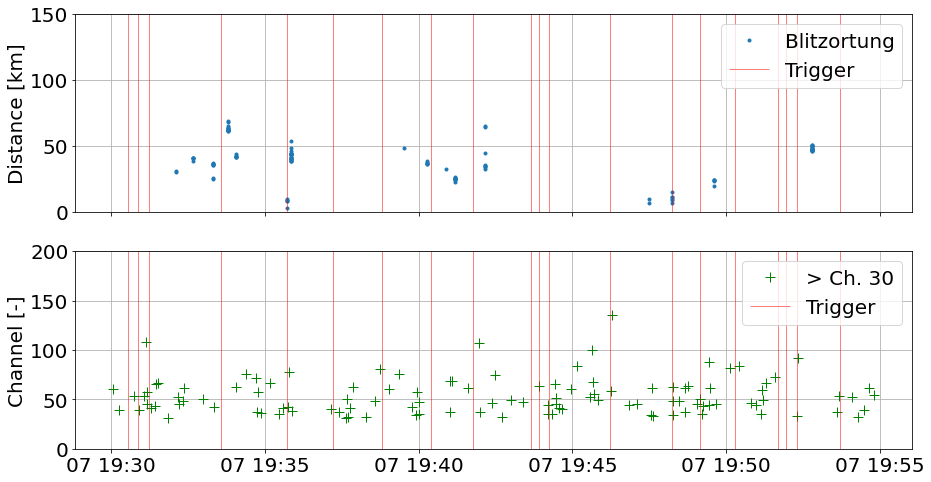
The Poledník event lasted tens of milliseconds, in the gap between the two established categories, and occurred during a period of regional thunderstorm activity while the closest localised lightning discharge was many kilometers away. This is consistent with a non-local mechanism or a remote driver, rather than direct overhead generation.
This finding is reported in: I. Ambrožová, M. Kákona, H. Kyznarová, P. Novák, J. Kákona, J. Šlegl, M. Tesař, O. Velychko, O. Ploc, Monitoring of ionizing radiation from thunderstorms in Bohemian Forest using standalone device GEODOS, Silva Gabreta 30, 63–71, 2024.
Two independent publications in 2024 reported signals of similar duration (Østgaard et al., Nature 2024; Marisaldi et al., Nature 2024), independently supporting the existence of a new class of intermediate-duration thunderstorm radiation events.
Publications
- Monitoring of ionizing radiation from thunderstorms in Bohemian Forest using standalone device GEODOS. Read online (NP Šumava, 2024)