Stratospheric balloon campaigns with AIRDOS-class detectors
AIRDOS detectors have been the primary scientific payload in a series of FIK stratospheric balloon flights operated jointly with the Nuclear Physics Institute of the Czech Academy of Sciences. The flights serve a dual purpose:
- Atmospheric radiation mapping — establishing the altitude dependence of secondary cosmic radiation up to ~30 km and the location of the Regener–Pfotzer maximum.
- Instrument qualification — testing AIRDOS and other detector designs against the temperature, pressure, mechanical, and electromagnetic environment of a stratospheric flight before they are deployed on a longer mission (UAV, satellite).
Multi-detector payload
A typical FIK-6 payload combined three different radiation detectors so that they could be cross-calibrated against the same air column on a single ascent:
- SPACEDOS — silicon PIN diode sensor, low mass, low power, very high resistance to mixed-field events.
- AIRDOS-C — scintillation detector with a small NaI(Tl) crystal coupled to a SiPM.
- G-M tube (STS-5) — high-volume Geiger–Müller counter for total-flux reference.
All three detectors plus the supporting sensors (T/p/RH, IMU, GNSS) were carried inside a polystyrene gondola flown by a Hwoyee Weather Balloon 1600 in the FIK-6 configuration:
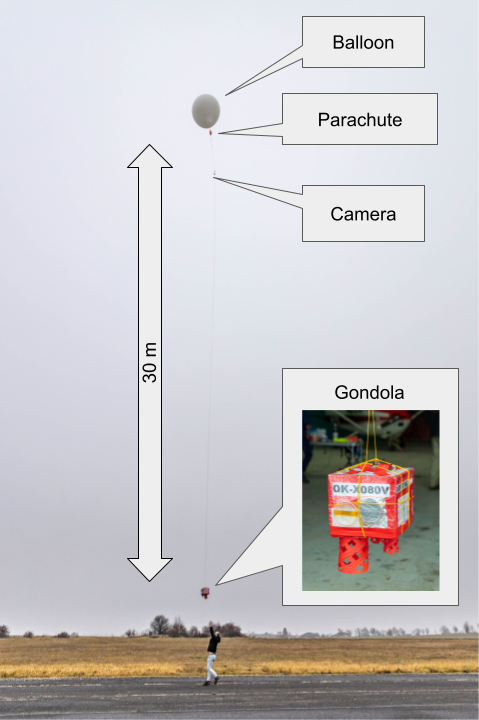
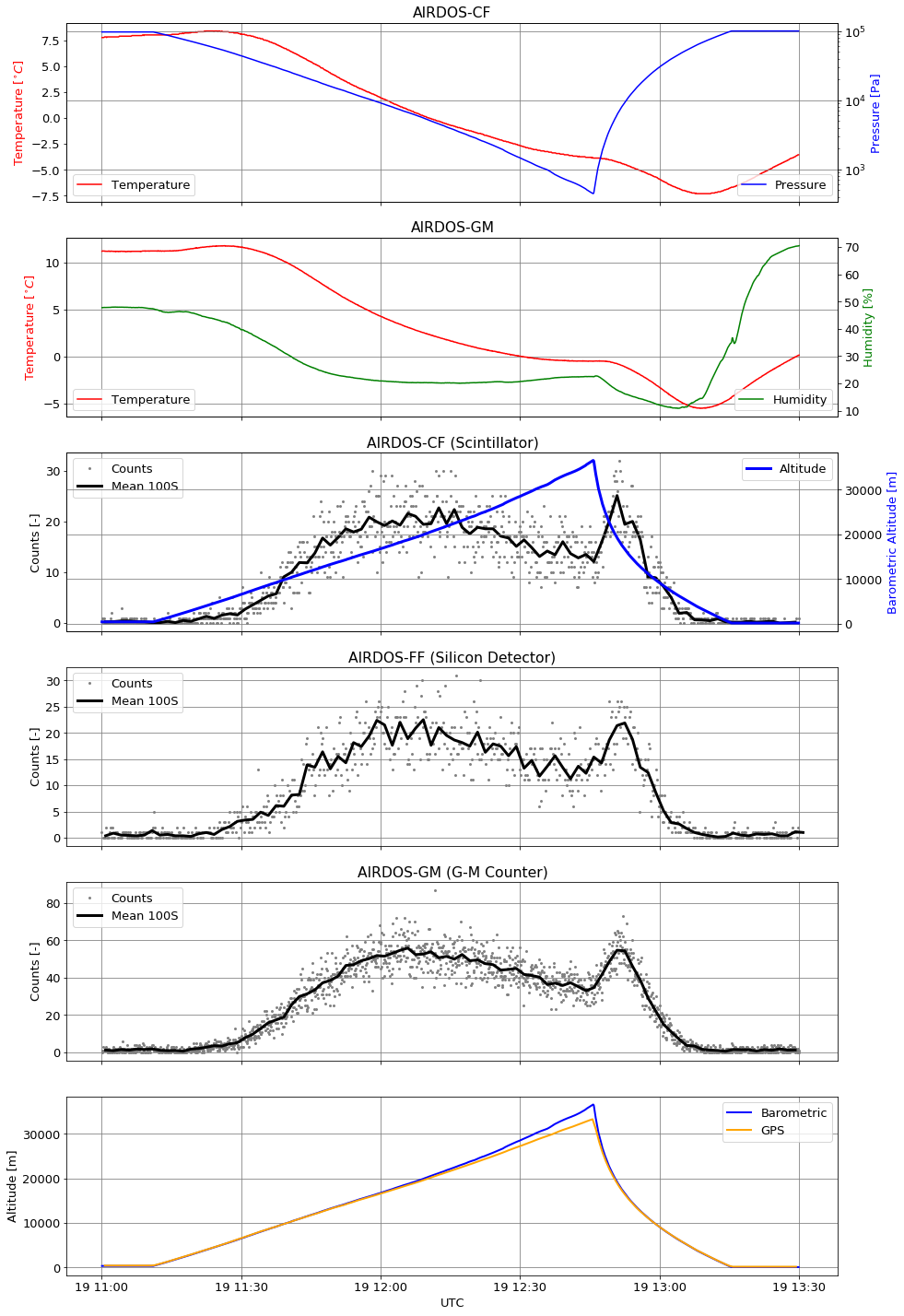
The TF-ATMON-based avionics recorded the full sensor suite throughout each flight. An example of the raw data — temperatures, pressure, humidity, three detector count rates, and altitude — from FIK-6:
Why telemetry data matters
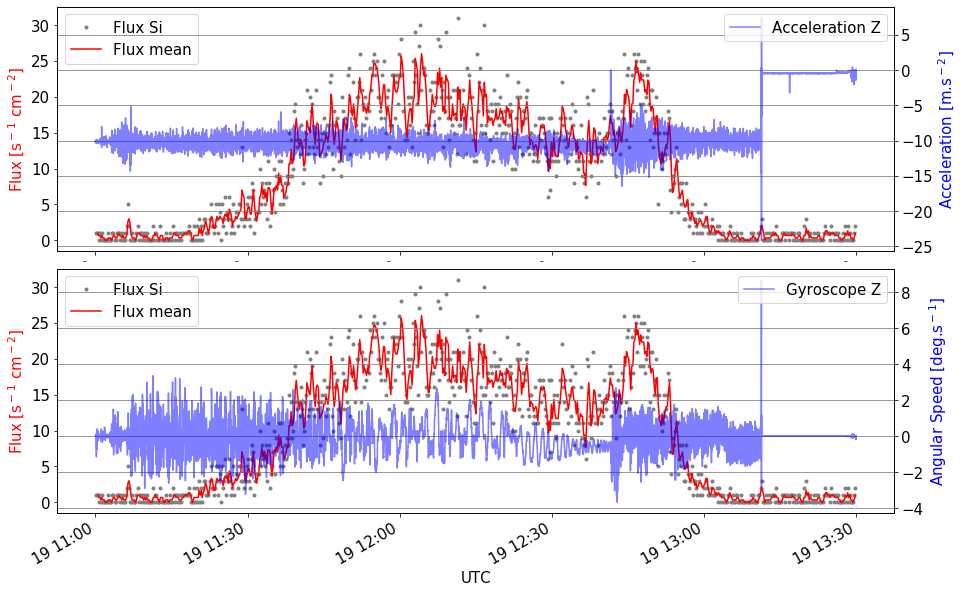
The combined flight + radiation record shows several effects that would have been misinterpreted without simultaneous mechanical telemetry. The acceleration and angular-rate trace from the IMU reveals that the silicon PIN diode count rate spikes at takeoff, balloon burst, and landing — a microphonic effect of the detector electronics, not a real radiation increase. The increased noise during the descent is similarly associated with rotation and high angular rates of the gondola:
The TF-ATMON architecture, with balloon-specific avionics decoupled from the detector payload, makes this kind of cross-correlation routine — every payload publishes its data to the same logger, sharing time, position and environmental context.
Regener–Pfotzer maximum
A central result of the FIK campaign is the joint determination of the altitude of the Regener–Pfotzer maximum from all three detector types on the same air column. A log-normal fit to the measured count rate vs. altitude gives a maximum near 19 km for all three detectors (G-M tube, NaI(Tl) scintillator, and silicon PIN diode):
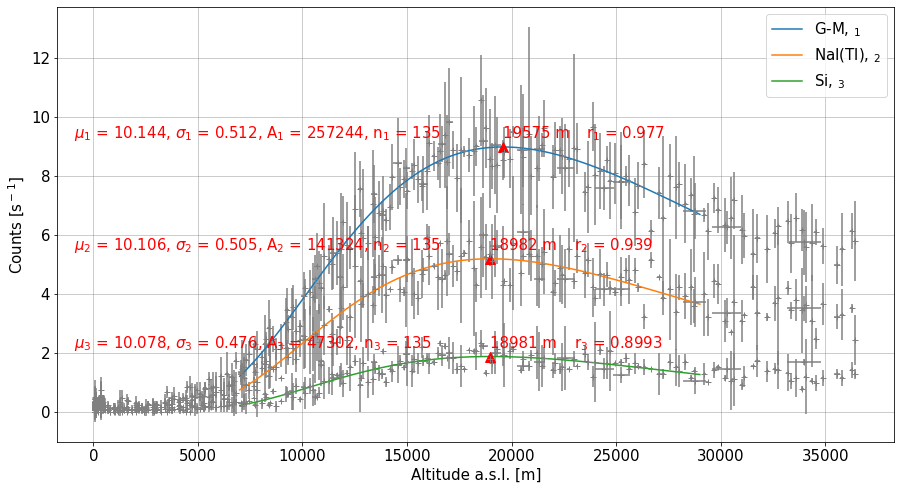
The methodology, including the use of TF-ATMON and the comparison across detector types, is reported in: J. Kákona et al., Measurement of the Regener–Pfotzer maximum using different types of ionising radiation detectors and a new telemetry system TF-ATMON, Radiat. Prot. Dosim. 198(9–11): 712–719, 2022, and extended to latitudinal effects in Ambrožová et al., 2023.
Recovery and operational notes
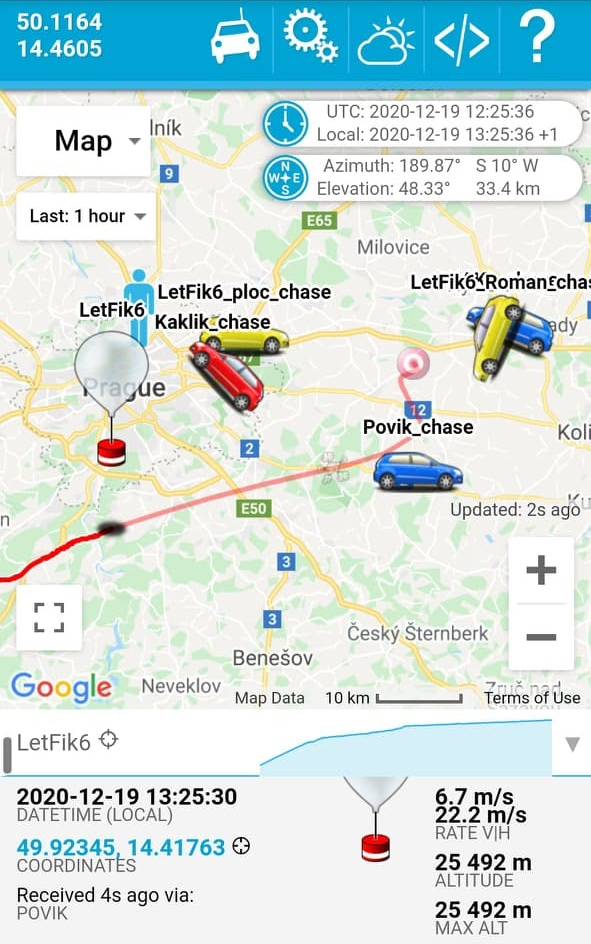
The TF-ATMON telemetry also makes balloon recovery practical: position and trajectory prediction were precise enough during the FIK-6 flight that the rescue team could observe the gondola touchdown directly and recover it within minutes:
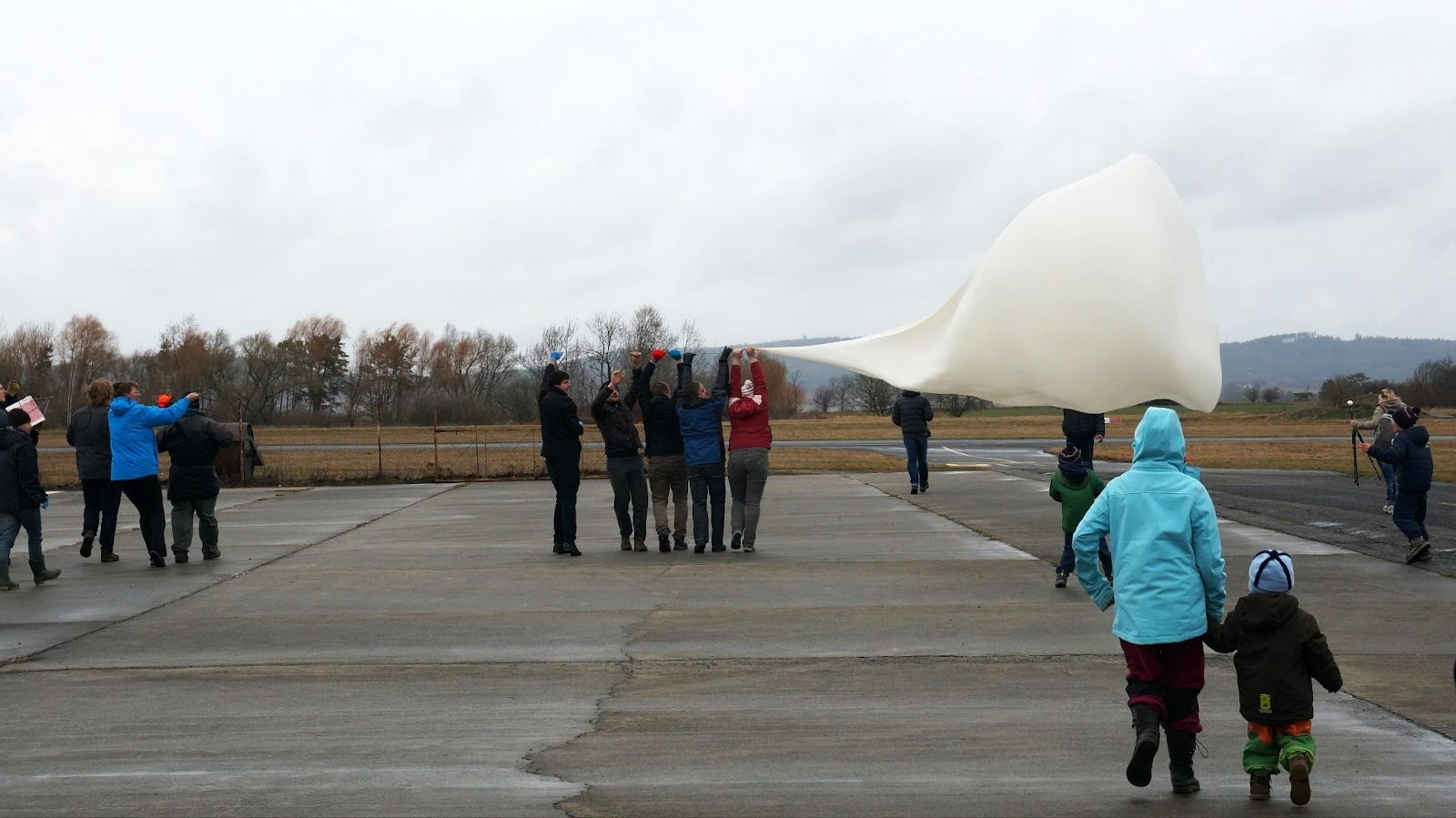
The main open challenge is launching balloons under the strong wind conditions that typically precede thunderstorm activity — these are exactly the conditions of scientific interest, but they are also when the gondola is most likely to impact terrain or the launching operator:
This is one of the reasons for the parallel development of the TF-G2 autogyro UAV platform — a controllable carrier that can position the same detectors in or near a storm cell with much higher reliability than an uncontrolled balloon. The latest AIRDOS03 variant was designed specifically for that UAV use.
Related publications
- J. Kákona et al., Measurement of the Regener–Pfotzer maximum using different types of ionising radiation detectors and a new telemetry system TF-ATMON, Radiat. Prot. Dosim. 198(9–11): 712–719, 2022.
- I. Ambrožová et al., Latitudinal effect on the position of Regener–Pfotzer maximum investigated by balloon flight HEMERA 2019 in Sweden and balloon flights FIK in Czechia, Radiat. Prot. Dosim. 199(15–16): 2041–2046, 2023.
- J. Kákona, Detection of Electromagnetic Phenomena in the Atmosphere – Integrating Advanced Instrumentation and UAVs for Enhanced Atmospheric Research, doctoral thesis, CTU in Prague, 2025.